Vision-Language-Action Navigation

Overview
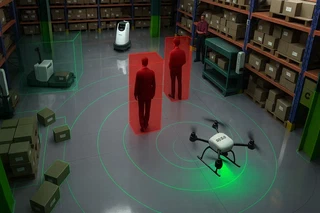
Vision-Language-Action (VLA) Navigation is an ongoing research project that aims to develop a universal autonomous navigation framework capable of controlling both aerial and ground robots directly from visual observations and natural language instructions.
The goal is to eliminate traditional modular navigation pipelines by learning an end-to-end policy that maps perception and language directly to robot actions.
Research Motivation
Current robotic navigation systems typically consist of separate perception, localization, mapping, planning, and control modules. While effective, these pipelines are often difficult to generalize across different robot platforms and environments.
Inspired by recent advances in foundation models and embodied AI, this project investigates whether a single Vision-Language-Action model can generalize navigation behaviors across multiple robotic platforms.
Research Objectives
- Universal navigation across multiple robot platforms
- End-to-end visual navigation
- Natural language robot control
- Cross-domain generalization
- Sim-to-real deployment
- Resource-efficient inference
Target Platforms
- Autonomous Tiny Drones
- Mobile Robots
- Autonomous Vehicles
- Legged Robots
Input Modalities
- RGB Images
- Video Streams
- Natural Language Instructions
- Robot State Information
Example instructions include:
- “Navigate to the red chair.”
- “Avoid pedestrians.”
- “Move to the charging station.”
- “Fly through the open doorway.”
Output
The model directly predicts navigation actions such as:
- Linear velocity
- Angular velocity
- Steering commands
- Drone velocity commands
- Waypoints
Planned Architecture
The proposed framework combines:
- Vision Encoder
- Language Encoder
- Multimodal Fusion
- Action Decoder
to produce end-to-end navigation commands.
Simulation Platforms
- NVIDIA Isaac Sim
- NVIDIA Omniverse
- CARLA
- Webots
- ROS 2
Potential Applications
- Autonomous driving
- Drone navigation
- Warehouse automation
- Search and rescue
- Industrial inspection
- Service robotics
Current Status
This project is currently under active development as part of my PhD research at the University of Illinois Chicago.
Future Directions
Future work includes:
- Multi-robot collaboration
- Long-horizon navigation
- Outdoor deployment
- Continual learning
- Foundation models for autonomous robotics
- Deployment on embedded robotic platforms
