TinyDrone-MicroNav

Overview
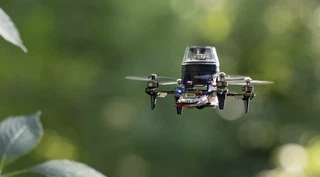
TinyDrone-MicroNav is an autonomous navigation framework for nano aerial vehicles that enables safe and efficient navigation using onboard perception and lightweight planning algorithms. The project focuses on resource-constrained platforms such as the Crazyflie 2.1 and aims to bridge the gap between simulation and real-world deployment.
Motivation
Autonomous navigation remains challenging for ultra-lightweight drones because of their limited sensing, computation, memory, and battery capacity. This project investigates how lightweight perception, planning, and learning algorithms can enable reliable navigation in dynamic environments.
Key Features
- Vision-based autonomous navigation
- Dynamic obstacle avoidance
- Local path planning
- Global recovery strategy
- Webots simulation
- Crazyflie 2.1 deployment
- Simulation-to-real transfer
- Lightweight algorithms for embedded platforms
Hardware
- Crazyflie 2.1
- Multi-ranger Deck
- Flow Deck
- Onboard IMU
Software
- Python
- Webots
- Crazyflie Python Library
- OpenCV
- NumPy
Current Research
Current work focuses on integrating:
- Deep Reinforcement Learning
- Vision-Language-Action Models
- TinyML
- Embedded AI
- Efficient onboard perception
to improve autonomous navigation under severe computational constraints.
Future Work
Future directions include:
- End-to-end visual navigation
- Multi-drone collaboration
- Real-world outdoor navigation
- Embedded deployment of foundation models
- Fully onboard autonomous flight
Project Status
Status: 🚧 Active Research Project
This project is currently under active development as part of my PhD research at the University of Illinois Chicago.
