Salamander Robot

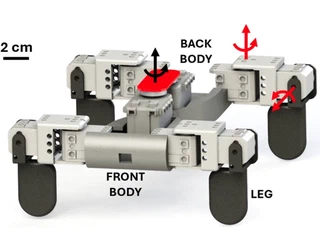
Overview
The Salamander Robot project investigates how spinal joint actuation can improve the locomotion efficiency, stability, and adaptability of bio-inspired quadruped robots. The project combines reinforcement learning with robotic simulation and real-world experiments to study coordinated spine–limb motion across different terrains.
Motivation
Many quadruped robots rely solely on leg motion for locomotion. Inspired by salamanders and other sprawling animals, this research explores how an actively controlled spinal joint can improve mobility and robustness.
Key Features
- Bio-inspired quadruped robot
- Deep Reinforcement Learning (DQN)
- Active spinal joint
- ROS and Gazebo simulation
- Sim-to-real deployment
- Raspberry Pi onboard control
- Terrain adaptability analysis
Hardware
- Custom Salamander Robot
- Dynamixel Servo Motors
- Raspberry Pi
- Custom mechanical design
Software
- ROS
- Gazebo
- Python
- C++
- Deep Q-Network (DQN)
Research Contributions
The project investigates:
- Coordinated spinal and limb dynamics
- Reinforcement learning for locomotion
- Terrain adaptation
- Efficient gait generation
- Bio-inspired robot control
Publications
Related publications include work presented at robotics workshops and conferences on bio-inspired locomotion and reinforcement learning.
Future Work
Future research includes:
- Vision-based locomotion
- Model-based reinforcement learning
- Outdoor terrain adaptation
- Foundation models for robot locomotion
Project Status
Status: ✅ Completed Research Project
This project was developed during my research at the University of Notre Dame under the supervision of Dr. Yasemin Ozkan Aydin.
